Australia Flag Pictures History

 Australian flag flies high Down Under

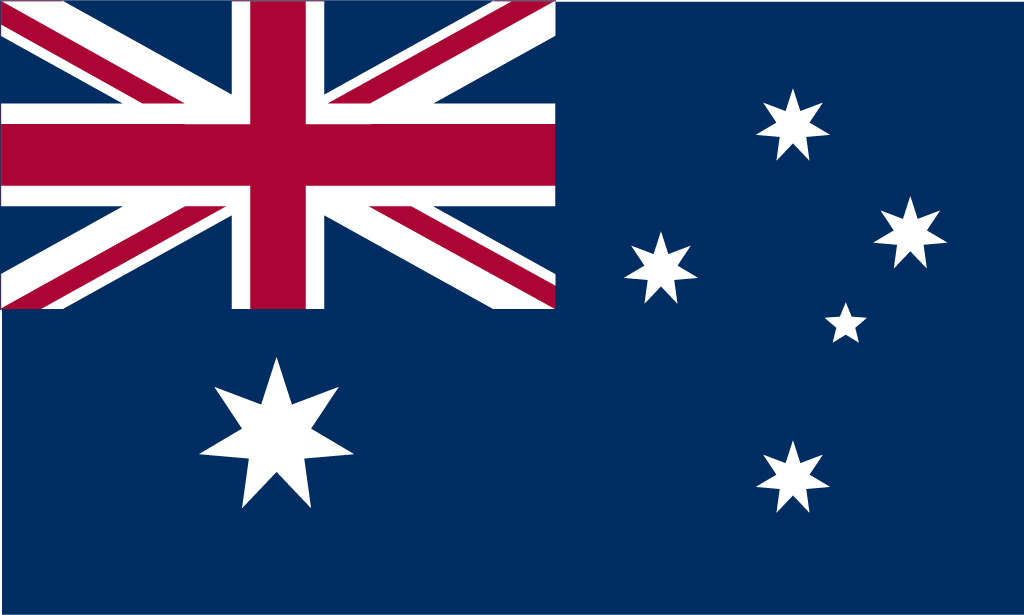
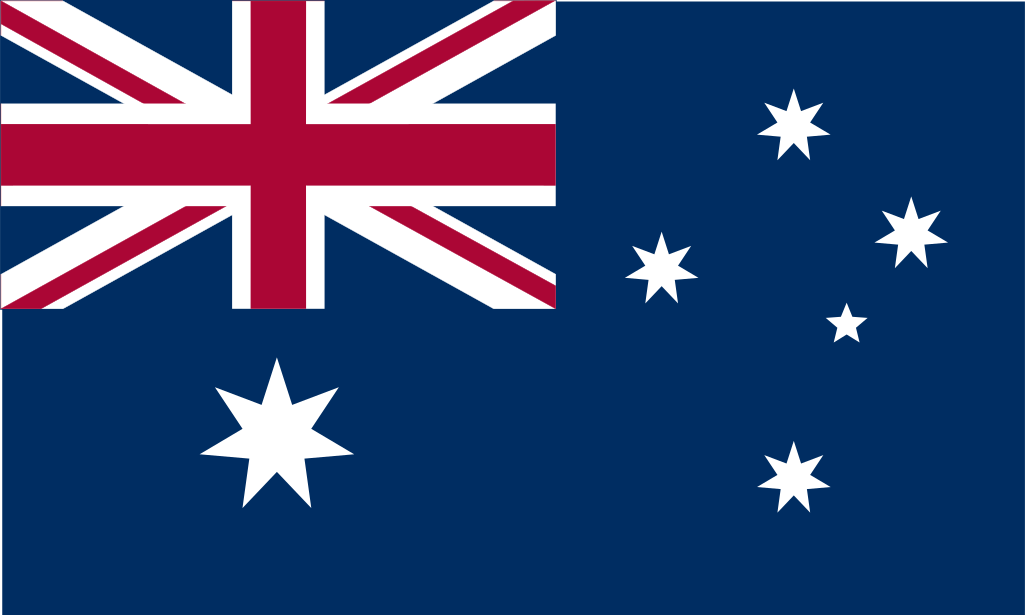
Australia's official national flag speaks to both the continent nation's history and geography. The blue flag includes the United Kingdom's Union Jack in the upper left quarter, the seven-point Commonwealth Star centered below it in the bottom left quarter, and the five stars arranged as the Southern Cross constellation.

Finding Australia

The Union Jack represents Australia's long association with Great Britain, first as a penal colony settlement, then a colonial dependent, then as a sovereign Commonwealth.

Before Europeans discovered Australia, the first residents of Australia were the Aborigines, who are thought to have come to the continent from Southeast Asia ten of thousands of years before recorded history. Today, Aborigines comprise less than 1 percent of the country's estimated population of approximately 21 million.

While Spanish and Dutch explorers became aware of the continent in the 16th and 17th centuries, the British gained control of the continent, after Captain James Cook landed near Botany Bay in 1770 and claimed the Australia coast for England. Eight years later, the first British settlement was established  a penal colony at Port Jackson, now the site of Australia's largest city, Sydney. By 1829, Britain claimed Australia as a British dependency. By mid-century, through systematic colonization by the British, permanent settlements had entirely replaced the penal colonies.

History of Federation

The white Commonwealth Star on the Australian flag has seven points, six of which represent the original states of federation and one representing Australia's internal and external territories.

Throughout the 19th century attempts were made to create a federation of the colonies of Australia. But not until July 5, 1900, was the Commonwealth of Australia Constitution Act passed. Four days later it was approved by Queen Victoria, and on Jan. 1, 1901, the Commonwealth of Australia was officially proclaimed.

Today, the Commonwealth of Australia covers the entire continent of Australia. The continent, located between the Indian and South Pacific oceans, is the smallest of the world's seven continents with a land area estimated to be about the size of the 48 contiguous states of the United States; the country is the sixth largest in the world. The Commonwealth includes six states  New South Wales, Queensland, South Australia, Tasmania, Victoria, and Western Australia  and two territories  Australian Capital Territory and Northern Territory. All of the states and territories are situated on the continent except Tasmania, which is an island state just south of Melbourne across the Bass Strait. In addition, the following dependent areas are part of the Commonwealth: Ashmore and Cartier Islands, Christmas Island, Cocos (Keeling) Islands, Coral Sea Islands, Heard Island and McDonald Islands, Norfolk Island, and Macquarie Island.

Unique Situation

The white stars (one smaller five-pointed star and four larger seven-pointed stars) on the national flag depict the Southern Cross constellation, recognizing Australia's geographical location in the southern hemisphere, where the constellation distinctly visible.

The continent's location, long-isolated land mass, age, and extremely variable weather patterns make Australia's ecology one of the most unique and diverse on earth. The country's Great Barrier Reef off the northeast coast is the world's largest coral reef. A few of its distinct wildlife species include kangaroo, koala, emu, and platypus.

These familiar animals were featured on several of the more than 32,000 entries received when the Australia government held a contest in 1901 to choose the design for the new Commonwealth's flag. In the end, however, the current design was chosen.

Flags and designs today

Today, a quiet but persistent debate still exists concerning the flag's design, mainly whether the Union Jack should be removed. There are two lobby groups involved in the flag debate, the pro-change group Ausflag and the Australian National Flag Association, who want to keep the current flag.

The current design was formally named the national flag of Australia in the Flags Act of 1953. Amendment to the Flags Act in 1995 added the Aboriginal Flag and the Torres Strait Islander Flag to the list of official Australia flags.

The Aboriginal Flag, designed in 1971 as a protest flag, consists of a black horizontal stripe over an equal-width red stripe with a yellow circle in the center of the flag. The Torres Strait Islander Flag, designed in 1992, features a green horizontal stripe at the top and bottom with an equal-width horizontal blue stripe between them and a white five-point star surrounded by a white headdress placed in the center of the flag.

In 1996, Sept. 3 was proclaimed Australian National Flag Day. While not a national holiday, the Australia National Flag is flown in public and private on this and other holidays, including Jan. 1, the celebration of the federation of colonies in 1901.

Flags are flown on the two official national days: Australia Day on Jan, 26, commemorating the arrival of the first British ship; and ANZAC Day, commemorating the landing of Australia and New Zealand Army Corps troops at Gallipoli, Turkey, during World War I on April 25, 1915.


Buy Australian flags at United-states-flag.com


More Australian flag information:

Australian National Flag Association site

Prime Minister of Australia official site

Official government flag site

Australian flags throughout history at Vexilla Mundi

Australian flag facts at Flags of the World

Australian facts at CIA's World Factbook

Australian Commonwealth and territory flags at theodora.com

Australian flag information at World Flag Database

Aussie-info.com


In the past it was not always easy for everyone to show their national pride or belief system with traditional flags. If you did not have a flagpole, the flag may not be displayed properly or where others could see it. Today, with a world of technology around us, it has become possible to display your beliefs in an easier manner. At FlagPictures.org, we carry free computer wallpaper, free cell phone wallpaper, free buddy icons, free vector printable clip art, free avatars, screensavers, and more from our large image library! All of these images are royalty free and wont cost you a dime, not even for the high resolution downloads!


Printable Downloads

australia

Printable Downloads

australia
Copyright © 2008 Online Stores, Inc.
Flag Pictures! Free vector print ready downloadable flags of the world!
Popular flags and Search by Region!