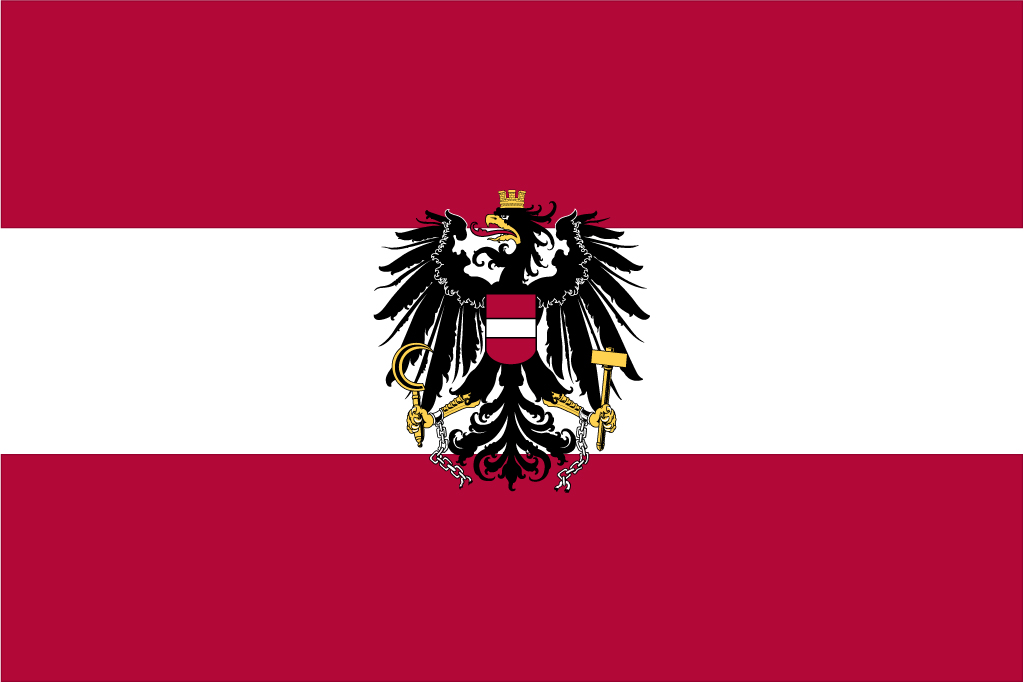
Austria Flag Pictures

 Austria's flag created long before the Republic

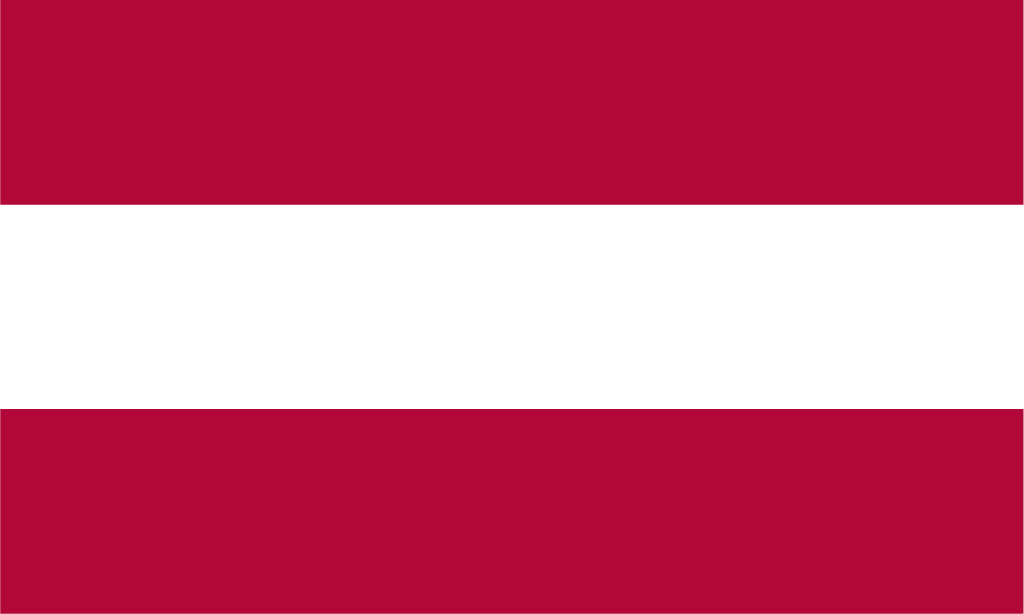
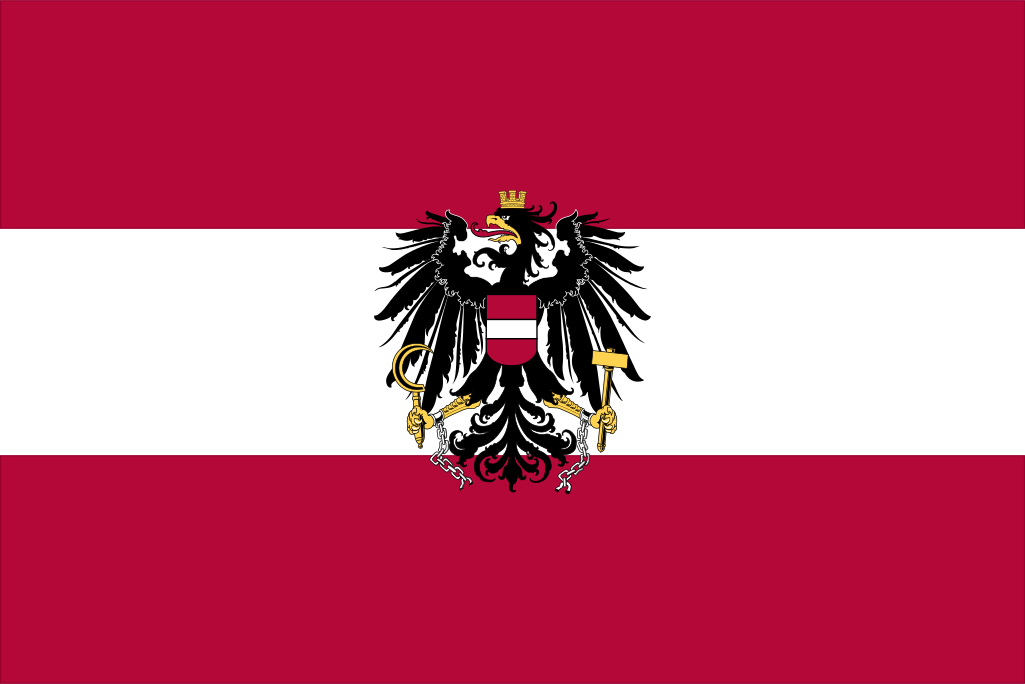
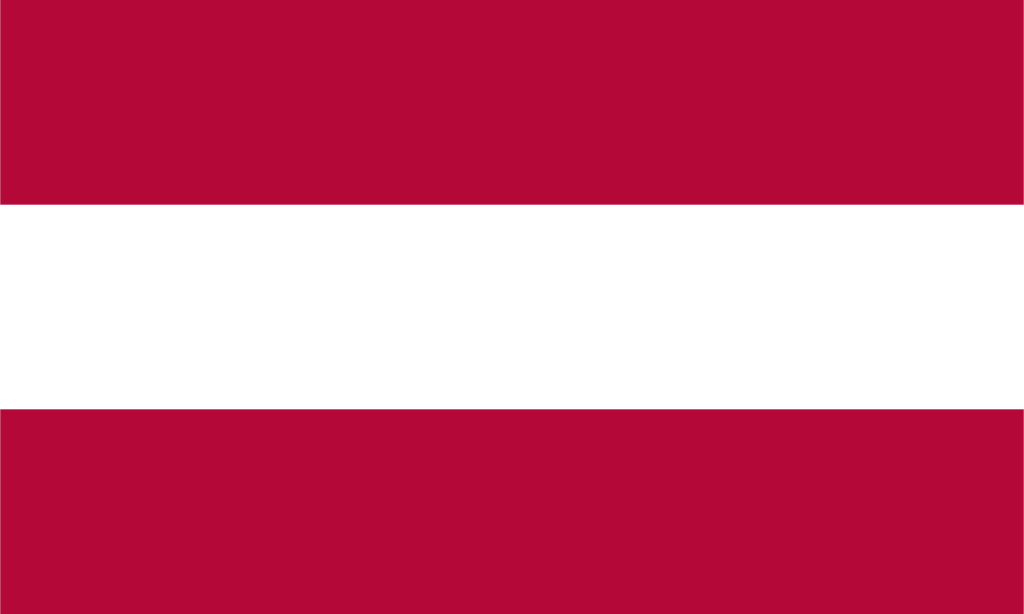
Austria's flag is older than its national status. While derived from provincial flags within the various empires under which it fell, the red-white-red flag was not flown as Austria's national flag until 1918.

The first documentation of a red-white-red flag of Austria is said to be from 1230, when Duke Friedrich II (1210-1246), the last Babenberg ruler of the Duchy of Austria, sought an identity independent from the Holy Roman Empire. Legend says the Duke was inspired by the undocumented, but often repeated, tale of Duke Leopold V of Austria (1157-1194), who after bloodied in battle during the Crusades removed the belt from his white tunic to reveal the red, white, red, which he used as his banner.

Imperial periods

From the Middle Ages to the 20th century, Austria was a central part of the Habsburg Empire, which included lands of present-day Austria and, at various periods, stretching and shrinking roughly from there to as far north-south as Germany and Italy, east-west from Romania and Russia to Switzerland, and even into Spain.

Prior to the Habsburg rule, Austria was an eastern border province, first under Charlemagne (747-814), then under the Holy Roman Empire (ca. 962-1806). Many historians trace the beginning of Austria's modern geographical history to 976 when Otto II, German King and Holy Roman Emperor, established the Margravate of Austria and named Leopold von Babenberg its ruler. The German name for Austria - Oesterreich - translates as Eastern Kingdom.

In 1156, Austria's status was elevated to a duchy, giving the area greater independence from the empire. The Babenberg family ruled the duchy until 1246, at which time Bohemian King Ottokar II of the Premysl dynasty married the last Babenberg sister and ruled until Rudolf von Habsburg, who was named German emperor, took over in 1278. The Habsburgs ruled Austria and its largely Central European empire for the next 640 years.

The Habsburg dynasty's empire, Austria-Hungary (since 1867), ended following its defeat World War I. In fact, the 1914 assassination of Arhcduke Franz Ferdinand, next in line to the Habsburg throne, by a revolutionary Serb named Gavrilo Princip sparked the series of war declarations that led to the World War.

First Republic

Austria was proclaimed a republic in 1918 and its new flag - three equal horizontal bands of red-white-red - flew for the first time on Nov. 12, 1918. ( Flags and Arms of the Modern Era)

In 1919, the Treaty of St. Germain officially ended Habsburg rule and established the Republic of Austria which included close to its present-day boundaries, or the German-speaking sections of the former empire. The red-white-red was officially named the national flag of Austria at that time. In 1920, Austria passed its first republican Constitution, which includes official adoption of the flag.

The Anschluss

Between the world wars, Austria suffered political and economic instability. Strikes, violence, unemployment (est. 25 %), and political party conflicts, including an attempted coup by the National Socialist party in 1934, led many Austrians to support the Germans when in 1938 Hitler sent in troops and annexed Austria into his Third Reich. ( U.S. State Department background notes) This period in Austrian history is referred to as the "Anschluss," meaning annexation. During this period, the Austrian national flag was banned, and the red flag with the Nazi swastika flew over Austria.

Austria's reaction to the Anschluss and actions during the Nazi rule is still scrutinized critically. In 1994, Austrian President Thomas Klestil told the Israeli Knesset that Austrian leaders "...spoke far too rarely of the fact that some of the worst henchmen of the NS dictatorship were in fact Austrians. .... In the name of the Republic of Austria, I bow my head before the victims of that time." ( U.S. State Department background notes) The Austrian government maintains a Web site concerning restitution and compensation through the National Fund for Victims of National Socialism and the General Settlement Fund.

Postwar occupation and beyond

In 1945, the Austrian flag was hoisted again, but Austria, like Germany, was divided into zones to be occupied by the four Allied governments - U.S., U.K. U.S.S.R, and France. This occupation ended in 1955 with the Austrian State Treaty, in which all lands were returned to the Republic and all occupying forces left the country. That same year, a constitutional law declared Austria's "perpetual neutrality." Austria joined the European Union in 1995 and the EU Economic and Monetary Union in 1999.

Best knowns

Austria's best known cities are Vienna, the capital and cultural center; Salzburg, the birthplace of Mozart and filming location for the 1965 movie "The Sound of Music"; Innsbruck, site of the 1964 and 1976 Winter Olympic games; and Linz, located on the Danube River and the country's third largest city.

A few of the country's most famous natives include founder of psychoanalysis Sigmund Freud; composers and musicians Joseph Haydn, Wolfgang Amadeus Mozart, Gustav Mahler, Johann Strauss, and Franz Schubert; artist Gustav Klimt; author filmmakers Otto Preminger, Fritz Lang, and Fred Zinnemann; actors Klaus Maria Brandauer, Maximilian Schell, Erich von Stroheim, and Hedy Lamarr; movie star/politician Arnold Schwarzenegger; chef Wolfgang Puck; and Simon Wiesenthal, a Ukraine native, who was an architectural engineer and Holocaust survivor who opened the Jewish Documentation Center in Vienna, where he documented Nazi crimes to aid in tracking down Nazi war criminals.

Public celebration

Austria's lone secular public holiday is celebrated as National Day on October 26. The holiday commemorates the date Austria declared neutrality.


Buy Austrian flags at United-States-Flag store


Below are links to resources on Austria's flag and history:

Pictures of Austrian historical flags at Vexilla Mundi

Austrian flag pictures and quick facts

Austrian facts CIA's World factbook

Virtual Vienna

Austria background notes at U.S. State Department

Austria entry in Philip's World Factbook 2008-2009

Austria on Encyclopedia of Nations

Other resources:

"Austria." World Almanac & Book of Facts; 2008, p749-749, 1/3p ISSN:0084-1382

"Beyond The Sound of Music: The Quest for Cultural Identity in Modern Austria," by Lamb-Faffelberger, Margarete, German Quarterly; Summer 2003, Vol. 76 Issue 3, p. 289-299, ISSN: 0016-8831


In the past it was not always easy for everyone to show their national pride or belief system with traditional flags. If you did not have a flagpole, the flag may not be displayed properly or where others could see it. Today, with a world of technology around us, it has become possible to display your beliefs in an easier manner. At FlagPictures.org, we carry free computer wallpaper, free cell phone wallpaper, free buddy icons, free vector printable clip art, free avatars, screensavers, and more from our large image library! All of these images are royalty free and wont cost you a dime, not even for the high resolution downloads!


Printable Downloads

austria
austria flag

Printable Downloads

austria
austria flag
Copyright © 2008 Online Stores, Inc.
Flag Pictures! Free vector print ready downloadable flags of the world!
Popular flags and Search by Region!