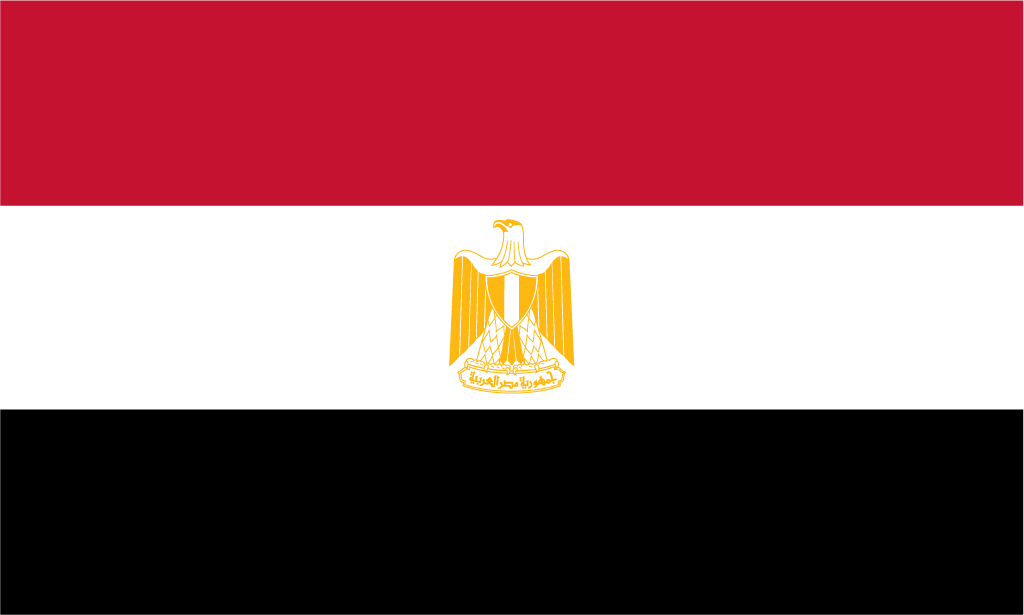
Egypt Flag History Pictures


 Flag of Egypt represents this
 ancient culture's modern nation

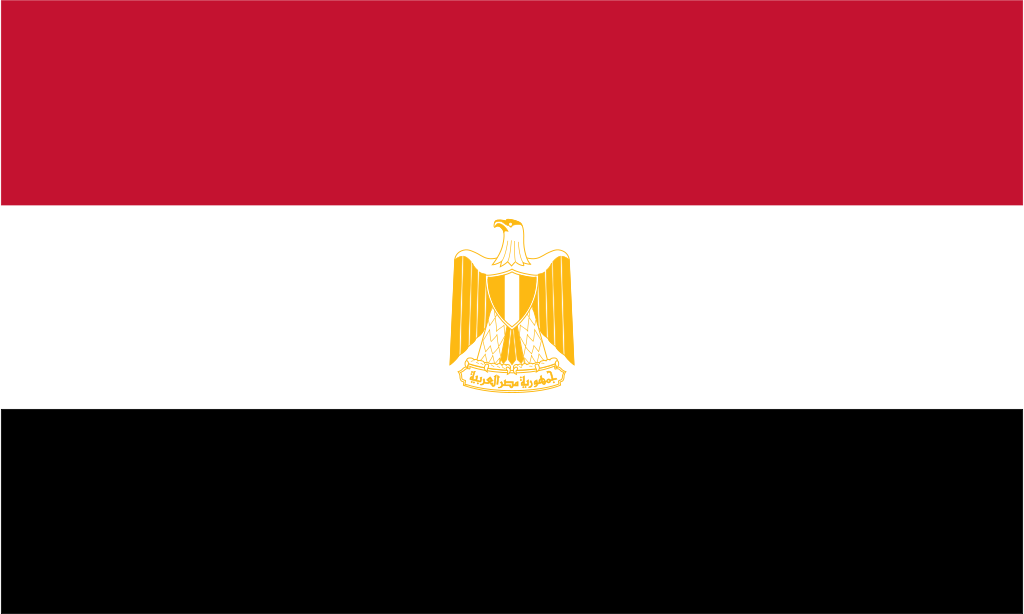
The flag of the Arab Republic of Egypt includes three equal horizontal stripes, from top, of red, white and black. In the center of the white band, the golden eagle of Saladin sits atop an inscription of the country's name.

According to the Egypt State Information Service, the red color symbolizes the struggle against British occupation of the country prior to the 1952 revolution that deposed King Farouk. The white band represents the bloodless nature of the revolution, and the black band recalls the end of the oppression of the Egyptian people at the hands of the monarchy and colonialism.

These colors have remained a constant base for the Egyptian flag since 1953; however, various emblems and symbols placed in the center white band have changed over the years.

Initially, from 1953-1958, the national flag featured an eagle with a crescent and stars design on its breast. In 1958, the eagle was replaced by two five-point stars representing the merger of Syria and Egypt into the United Arab Republic. The merger dissolved, however, in 1961, when Syria experienced a coup. Egypt continued to use the name United Arab Republic and its flag until 1972. Currrently, Syria uses the two-star flag, which it readopted in 1980.

In 1972, Egypt replaced the stars with a golden hawk emblem; and in 1984, the current eagle of Saladin replaced the hawk on the official Egyptian flag.

While Egypt is one of the world's oldest civilization, its modern national history dates from 1922, when Egypt gained partial independence from Great Britain, which had seized control of the government in 1882. At that time, Egypt had been under control of the Ottoman Empire since the Turks took over in 1517.

Ancient Egypt in Brief

The ancient kingdom of Egypt is estimated to have risen about 3200 BCE. For nearly three millennia, Egypt was ruled by dynasties of Pharaohs, before falling under Persian control in 341 BCE. For centuries, Egypt came under control of various foreign occupations and the area was influenced by Greek, Roman, Byzantine, Christian and Islamic cultures, each leaving its mark. The Mamluks, slave soldiers who converted to Islam and served the Ayyubid sultans and Muslim caliphs, took control about 1250 and continued to govern after the Egypt fell to the Ottoman Turks in 1517. The Ayubbid dynasty began with Saladin in 1169.

Suez Canal and Rise of Nationalism

The completion of the Suez Canal in 1869 made Egypt a transportation center, but it also placed the country in debt, making it vulnerable to the British takeover. From 1882 to 1914, Egyptian allegiance was divided between Britain, the Ottomans, and the rich cultural identity of the people. During this period Egyptian nationalism grew and prompted numerous rebellions.

Following World War I and the dissolution of the Ottoman Empire, Egypt gained partially independence through a new parliamentary constitution headed by a British-backed monarchy, and adopted its first modern national flag  a green background with a white crescent and three white stars in the center. The green color was said to symbolize the agricultural nature of the country in the Nile River basin; however, green is also the color associated with Islam. The crescent and stars is a common symbol throughout history, and the new Egyptian flag adopted the symbols, which also appeared on the last Ottoman Empire flag, which was red with a white crescent and one white star. The new flag was also similar to the Egyptian protest flag of 1919, which was green with a crescent and cross to show that both Muslims and the Coptic Christians of Egypt support independence.

Egyptian Revolution

When the monarchy was overthrown in 1952, Egypt adopted the red, white and black horizontal stripe background which remains today with the eagle of Saladin centered in the white stripe. Saladin (1138-1193) was of Kurdish descent (near modern-day Tikrit, Iraq). As a Muslim general, he led forces against the Crusaders. Saladin is generally regarded by Christians and Muslims for his leadership and upstanding qualities.

Flying the Egyptian Flag

Today, Egyptians celebrate their Independence Day on Feb. 22 (1922), and the national holiday of Revolution Day is observed on July 23 (1952).

According to Egypt State Information Service, "The national flag is hoisted on all governmental buildings on Fridays, official holidays, on the inauguration of the People's Assembly session and other occasions on which the Minister of Interior orders that the flag be hoisted."

The Service also states that "Abusing the flag in any way is a criminal offense and is punishable under law as it implies contempt of the power of the state. Penal provisions also govern abuse of foreign flags or national emblems of other countries."

Buy Egypt flags at united-states-flag.com

For more information on Egypt, its history and its flag, see:

Flags of the World

CIA's World Factbook

Egypt State Information Service

World Flag Database

We don't think you should have to pay for printable vector flag art so at FlagPictures.org, we offer a large selection of high res royalty free flag pictures and clip art flag images at no cost to you! Whether you're looking for wallpaper pictures for a computer backgrounds, cellphone wallpaper, avatars, buddy icons for AIM (AOL Instant Messenger), screensaver options and more we've got what you're looking for. Remember, even if your download is high resolution you'll never have to pay for these royalty free images!


Printable Downloads

egypt

Printable Downloads

egypt
Copyright © 2008 Online Stores, Inc.
Flag Pictures! Free vector print ready downloadable flags of the world!
Popular flags and Search by Region!